
America’s electric-car transition has taken an unexpected turn in the summer of 2026. The fastest-moving part of the electrified market is not the battery-electric vehicle. It is the conventional hybrid — the technology that Toyota introduced to American buyers more than two decades ago and that many in the industry once regarded mainly as a stepping stone toward full electrification.
The numbers explain why automakers are paying attention. US new-car sales fell 2.2% during the first half of 2026, according to Kelley Blue Book data, while hybrid sales increased 9%. Urban Science estimates hybrids represented 16.9% of US retail sales through June and reached an 18.1% share during the second quarter.
Rising fuel costs are providing an obvious incentive. The US Energy Information Administration reported an average regular gasoline price of $4.001 per gallon for the week of July 20, 2026 — $0.88 more than a year earlier.
But expensive gasoline is only part of the story.
The bigger change is happening inside dealerships. Hybrids are becoming easier to find, less unusual to drive and, increasingly, the default powertrain in some of America’s most familiar vehicles.
What You Need to Know
The hybrid surge comes at an unusual moment for the US automotive market.
Battery-electric vehicles are showing signs of recovery, but they remain well below their year-ago sales pace. Kelley Blue Book counted 247,226 new EVs sold during the second quarter of 2026, up 14.7% from the first quarter but down 20.5% compared with Q2 2025.
At the same time, a major financial incentive for EV buyers disappeared. The federal New Clean Vehicle Credit, which had been worth as much as $7,500 for qualifying vehicles, is no longer available for vehicles acquired after September 30, 2025. The used clean-vehicle credit ended on the same date.
That created a market in which a conventional hybrid can be easier to justify financially.
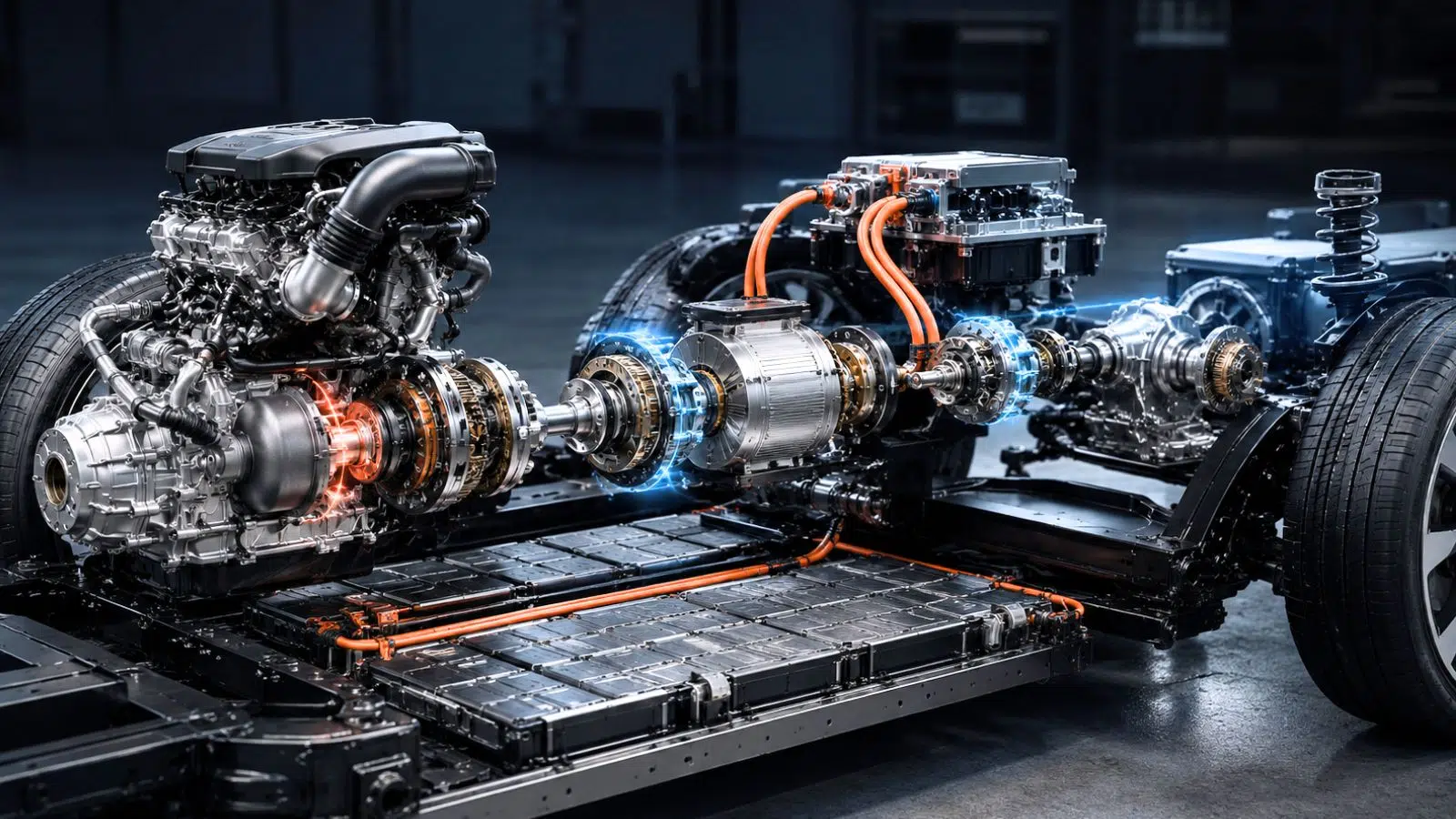
Unlike an EV, a regular hybrid does not need to be plugged in. A relatively small battery and one or more electric motors assist the gasoline engine, while regenerative braking recovers some energy that would otherwise be lost.
The result is better fuel economy, particularly in urban driving, without asking the owner to install a charger, plan road-trip charging stops or fundamentally change the way the vehicle is used.
That simplicity matters.
Why This Shift Is More Important Than Gas Prices
A spike in gasoline prices can make almost any fuel-efficient vehicle more attractive. But the current hybrid boom is different because automakers have spent years quietly removing many of the compromises that once came with buying one.
Toyota is the clearest example.
The company introduced the Prius to the US roughly 25 years ago and continued investing heavily in hybrid systems even when much of the industry was concentrating investment and marketing on battery-electric vehicles.
Today, hybrid technology is no longer confined to an unusual-looking economy car. It is embedded across Toyota’s mainstream lineup.
For 2026, the new-generation RAV4 has no conventional gasoline-only powertrain: buyers choose between a regular hybrid and a plug-in hybrid. The standard RAV4 starts at $31,900 and can achieve up to an estimated 47 mpg city and 40 mpg highway, depending on configuration.
Toyota’s results show how powerful that strategy has become. Toyota Motor North America reported 383,091 electrified-vehicle sales in Q2 2026, an increase of 19.5%. Toyota Division’s electrified mix reached a record 61.4%, while the RAV4 Hybrid recorded its best-ever result. Toyota’s “electrified” figures include more than conventional hybrids, but the performance illustrates how central electrified powertrains have become to the company’s US business.
And Toyota is far from alone.
Hyundai reported that its US hybrid sales surged 71% in the second quarter of 2026 and 67% during the first half of the year.
Honda has made hybrids a core part of high-volume products such as the CR-V, Accord and Civic. WIRED reports that hybrid versions accounted for 51% of CR-V sales in a recent period.
Ford has taken the concept into a completely different segment. The 2026 Maverick XL compact pickup comes standard with a 2.5-liter hybrid powertrain and starts at $28,145. It carries an EPA estimate of 42 mpg city, 35 highway and 38 combined in front-wheel-drive form.
That is the real story behind America’s hybrid moment: electrification is increasingly entering the market disguised as an ordinary car, SUV or pickup.
The Impact for Drivers
For buyers, the appeal of a conventional hybrid comes down to a combination of efficiency and convenience.
No charging routine
A standard hybrid refuels at a gas station like any conventional vehicle. There is no dependence on home charging or public charging infrastructure.
That makes hybrids particularly attractive to apartment residents, drivers without dedicated parking and households that regularly take long road trips.
Better efficiency where many people need it most
Hybrid powertrains are particularly effective in stop-and-go driving.
Electric motors can assist during acceleration, regenerative braking can recover energy during deceleration, and the gasoline engine can shut down under conditions where running it would waste fuel.
That is why vehicles such as the front-wheel-drive 2026 Honda CR-V Sport Hybrid can achieve an EPA-rated 43 mpg city, compared with 28 mpg city for the gasoline CR-V.
The price gap is becoming easier to accept
Hybrids are not automatically cheaper to own.
Purchase price still matters, and buyers covering relatively few miles may need years to recover a hybrid premium purely through lower gasoline consumption.
But the equation changes when the hybrid drivetrain becomes standard rather than optional.
Ford’s Maverick is one example. Toyota’s decision to eliminate the gasoline-only RAV4 for 2026 is another. Buyers are increasingly choosing between different kinds of electrification rather than deciding whether they want electrification at all.
There are still limitations
A conventional hybrid should not be confused with an EV.
It still burns gasoline and produces tailpipe emissions. It cannot normally travel meaningful distances using electricity alone, and its long-term fuel savings depend heavily on mileage, fuel prices and driving conditions.
Drivers who can charge at home and complete most daily journeys electrically may still find a battery EV — or in some circumstances a plug-in hybrid — more attractive.
Competitors and Alternatives
The strongest evidence for the hybrid boom is the variety now available. The technology is no longer concentrated in small sedans.
| Model | 2026 Starting MSRP | Efficiency | Why It Matters |
|---|---|---|---|
| Toyota RAV4 | $31,900 | Up to 47 city / 40 hwy mpg | America’s mainstream compact SUV formula is now hybrid-focused |
| Honda CR-V Sport Hybrid | $35,630 | 43 city / 36 hwy mpg, FWD | A direct RAV4 rival with a mature two-motor hybrid system |
| Hyundai Tucson Hybrid | $32,450 | Up to around 38 mpg combined, depending on trim | Shows how aggressively Hyundai is expanding in hybrids |
| Ford Maverick XL Hybrid | $28,145 | 42 city / 35 hwy / 38 combined | Brings hybrid efficiency to an affordable compact pickup |
| Toyota RAV4 Plug-in Hybrid | $41,500 | Up to 54 miles EPA-estimated electric range | An alternative for drivers who can charge but still want gasoline backup |
Manufacturer pricing and economy figures are current for the cited 2026 US models and can vary by drivetrain, trim, destination charges and options.
Conventional hybrid vs plug-in hybrid vs EV
For shoppers, the terminology is increasingly important.
Hybrid (HEV): Best suited to buyers who want better fuel economy without charging. The vehicle handles battery charging itself.
Plug-in hybrid (PHEV): Adds a much larger battery that can be charged externally, allowing some journeys to be completed without gasoline. Once the battery’s usable electric charge is depleted, the vehicle can continue operating with its combustion engine.
Battery EV (BEV): Runs entirely on electricity. There is no gasoline engine, which can dramatically reduce fuel and routine powertrain maintenance costs, but charging access becomes a central part of ownership.
There is no universally correct choice.
A suburban homeowner with a garage and predictable commuting pattern may get far more value from an EV or PHEV than from a regular hybrid. An apartment resident who travels hundreds of highway miles several times a month may find the conventional hybrid significantly easier to live with.
The best powertrain is therefore increasingly determined by how the car will be used rather than by which technology looks most advanced on paper.
Are Hybrids Hurting Electric Cars?
It is tempting to interpret the hybrid boom as evidence that Americans have rejected EVs.
The data does not support such a simple conclusion.
EV sales improved between the first and second quarters of 2026 even though they remained sharply lower than a year earlier. Meanwhile, the end of federal purchase incentives significantly changed the economics of buying a new EV.
In other words, the two technologies are operating under different market conditions.
Hybrids currently solve several problems simultaneously: fuel prices are high, new vehicles remain expensive, charging remains inconvenient for some households, and manufacturers can integrate hybrid systems into vehicles customers already recognize.
There is also a battery-supply argument in favor of hybrids. Because a conventional hybrid battery is far smaller than the pack used in a long-range EV, an automaker can electrify many more vehicles using the same quantity of battery cells.
The trade-off is obvious: each of those cars still relies on gasoline.
The hybrid boom therefore should not be seen as the end of the electric transition. It is better understood as evidence that the transition is becoming less linear.
What Buyers Should Consider Before Choosing a Hybrid
A hybrid makes the strongest case for itself when the vehicle will cover significant annual mileage, spend considerable time in city or suburban traffic and cannot be conveniently charged at home.
Before buying, shoppers should compare more than the EPA fuel-economy number.
Consider:
- The price difference between hybrid and gasoline versions, where both exist.
- Annual mileage and the percentage driven in city conditions.
- Current insurance quotes for each powertrain.
- Cargo or towing differences caused by the hybrid hardware.
- Whether home charging is available.
- How long the vehicle will realistically be kept.
- The price of comparable used hybrids.
Drivers should also test-drive different hybrid systems. They do not all behave alike. Some prioritize a smooth, almost EV-like response around town, while others make the gasoline engine more noticeable under hard acceleration.
What We Can Expect Next
The most significant consequence of America’s 2026 hybrid surge may be what automakers do next.
Manufacturers now have strong evidence that customers will accept electrification when it does not demand major behavioral changes.
Toyota is already benefiting from a strategy built around offering several forms of electrification. Hyundai’s 71% second-quarter hybrid sales increase provides another powerful incentive to expand supply. Ford has demonstrated that hybrid technology can work in a practical pickup, not merely in efficiency-focused cars.
That is likely to intensify competition.
Expect hybrids to spread further into SUVs, pickups and larger family vehicles rather than remaining an alternative powertrain offered on a handful of economy-focused models.
Gasoline prices may also cool. The EIA currently expects US retail gasoline to average just under $3.80 per gallon in the third quarter of 2026, lower than the more than $4.20-per-gallon average it reported for Q2.
That will provide an important test.
If hybrid demand stays strong even as gasoline becomes cheaper, it would confirm that 2026 is not simply another temporary fuel-price reaction.
And there are good reasons to think it could.
The modern hybrid no longer asks most drivers to make a statement about what powers their car. It asks whether they would prefer to visit the gas station less often.
For Toyota, Honda, Hyundai, Ford and a growing list of competitors, that may be the most effective electrification sales pitch the American market has heard yet.