
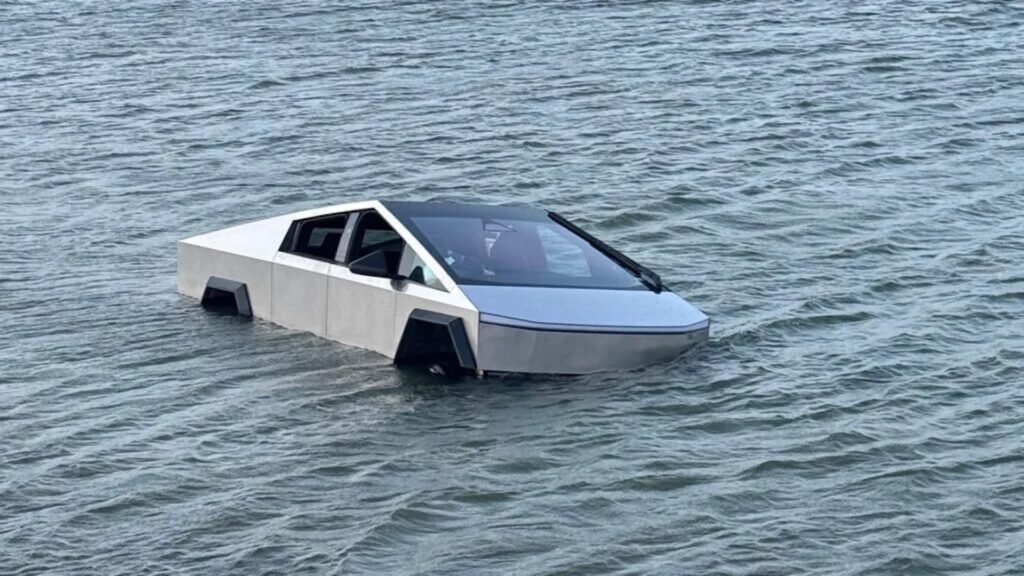
A Cybertruck Was Driven Into the Lake on Purpose
The incident took place near the Katie’s Woods Park boat ramp at Grapevine Lake in Texas. According to local police, the driver of the Tesla Cybertruck reportedly said he drove into the lake on purpose in an attempt to use the vehicle’s Wade Mode.
The situation quickly became a problem. The electric pickup became disabled in the water and began taking on water. The driver and a passenger were able to get out, and emergency crews later helped recover the vehicle from the lake.
The story gained attention online because the Cybertruck is often marketed as a rugged electric pickup designed for tough conditions. However, this incident shows that off-road features do not turn the vehicle into a boat.
What Is Tesla Cybertruck Wade Mode?
Wade Mode is a Tesla Cybertruck feature designed to help the vehicle cross shallow water in controlled conditions. When activated, the system raises the suspension and prepares certain vehicle components to better handle water and debris.
However, the feature has clear limits. Tesla states that Wade Mode is intended for shallow-water crossings, not deep water, lakes, or boating situations. The maximum recommended depth is around 32 inches, or about 81.5 cm, measured from the bottom of the tire.
Drivers are also expected to check the water depth, the surface underneath, and the surrounding conditions before attempting any water crossing.
Why Did the Cybertruck Get Stuck?
A lake can be unpredictable. The bottom may be muddy, uneven, soft, or deeper than it appears from the shore. A heavy vehicle like the Tesla Cybertruck can lose traction, sink into soft ground, or become immobilized if the surface is not stable.
In this case, police said the Cybertruck became disabled and started taking on water. That forced the occupants to leave the vehicle and required a recovery operation.
The incident is a reminder that driver-assistance and off-road features should not be treated as a challenge or a stunt. Wade Mode is meant for specific shallow-water crossings, not for intentionally driving into a lake.
Legal Consequences for the Driver
The driver also faced legal consequences after the incident. Local authorities reported several violations, including issues related to driving in a restricted park area and safety rules connected to the lake.
Police reminded the public that just because a vehicle has a feature designed for shallow water does not mean it can be used anywhere. Lakes, boat ramps, parks, and natural areas often have strict rules meant to protect people, property, and the environment.
Can the Tesla Cybertruck Really Drive Through Water?
Yes, but only in limited conditions. The Tesla Cybertruck can use Wade Mode to cross certain shallow-water areas, provided the driver follows Tesla’s instructions and uses good judgment.
That means driving slowly, keeping doors and windows closed, checking the water depth, and making sure the ground underneath is stable. Wade Mode is not designed for deep water, lakes, or floating.
Tesla also notes that water damage is not covered under the vehicle’s warranty, which means a mistake like this could become extremely expensive.
A Safety Reminder for EV Owners
This incident is also an important reminder for electric vehicle owners. Modern EVs come with advanced technology, but they are still limited by physics, safety rules, and the manufacturer’s guidelines.
Off-road modes can be useful when used correctly. They should not be used to test extreme limits, especially in water. Before driving through any flooded or wet area, drivers should understand the depth, the surface conditions, and the risks involved.
Wade Mode Is Not Boat Mode
The Grapevine Lake Cybertruck incident shows the difference between a water-crossing feature and an unsafe experiment. Tesla’s Wade Mode may help the Cybertruck cross shallow water in the right conditions, but it does not make the electric pickup amphibious.
For Cybertruck owners and EV drivers in general, the lesson is simple: advanced technology should be used responsibly. Driving into a lake to test a feature can damage the vehicle, create safety risks, and lead to legal trouble.